
Chinese checkers is a race game for two to six players. The goal is to be the first to move all ten of your pieces across a star-shaped board and into the triangle opposite your own. The rules take a few minutes to learn. This guide covers the board, the setup, how pieces move, how to win and a few tips, with diagrams. Want to try it first? Play Chinese checkers online for free.
In brief
- Players: 2, 3, 4 or 6. Five players do not fit the board.
- Pieces: 10 each, on a board with 121 holes.
- Goal: move all your pieces into the opposite triangle first.
- Moves: one step to a neighboring hole, or a hop over a piece into the empty hole right behind it. Hops can be chained.
- No captures: pieces never leave the board.
The board and the pieces
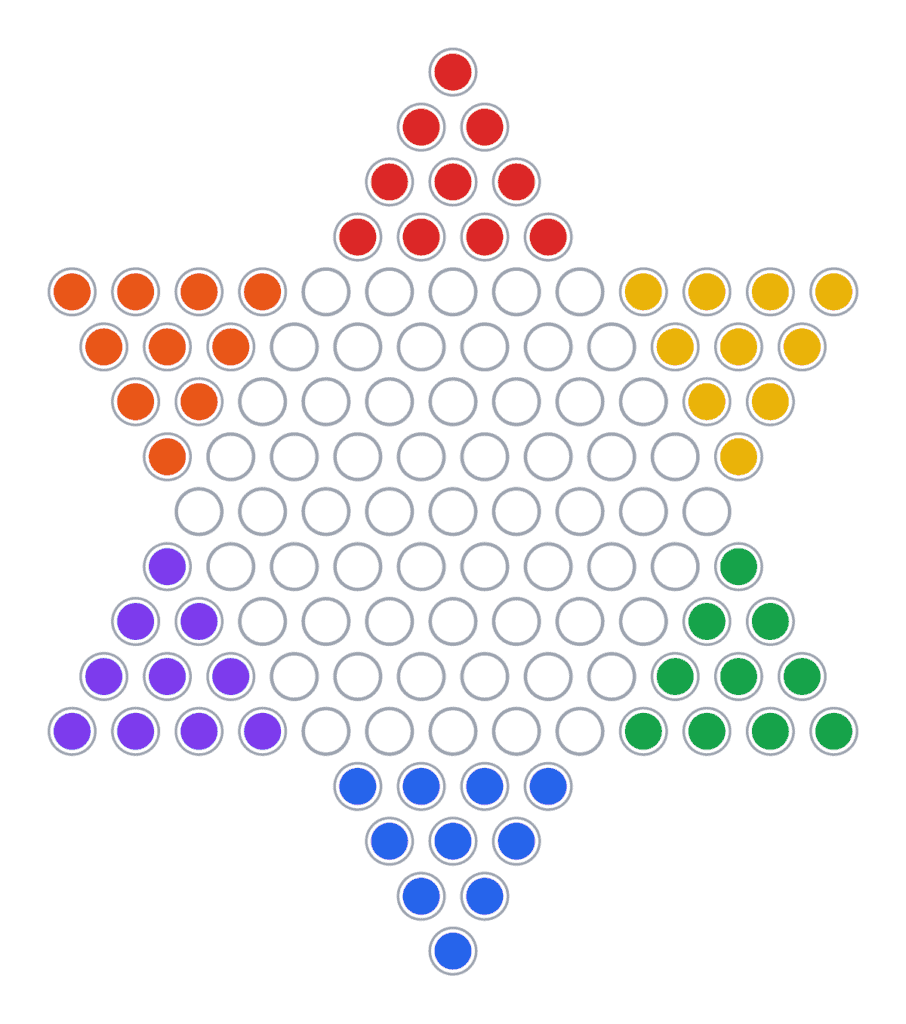
The board is a six-pointed star with 121 holes. Each point of the star is a triangle of 10 holes, and the large area in the middle is where the players meet. Each player has 10 pieces of one color, usually marbles or pegs, which start in one triangle. The goal is the triangle directly across the board.
Setup for 2, 3, 4 and 6 players
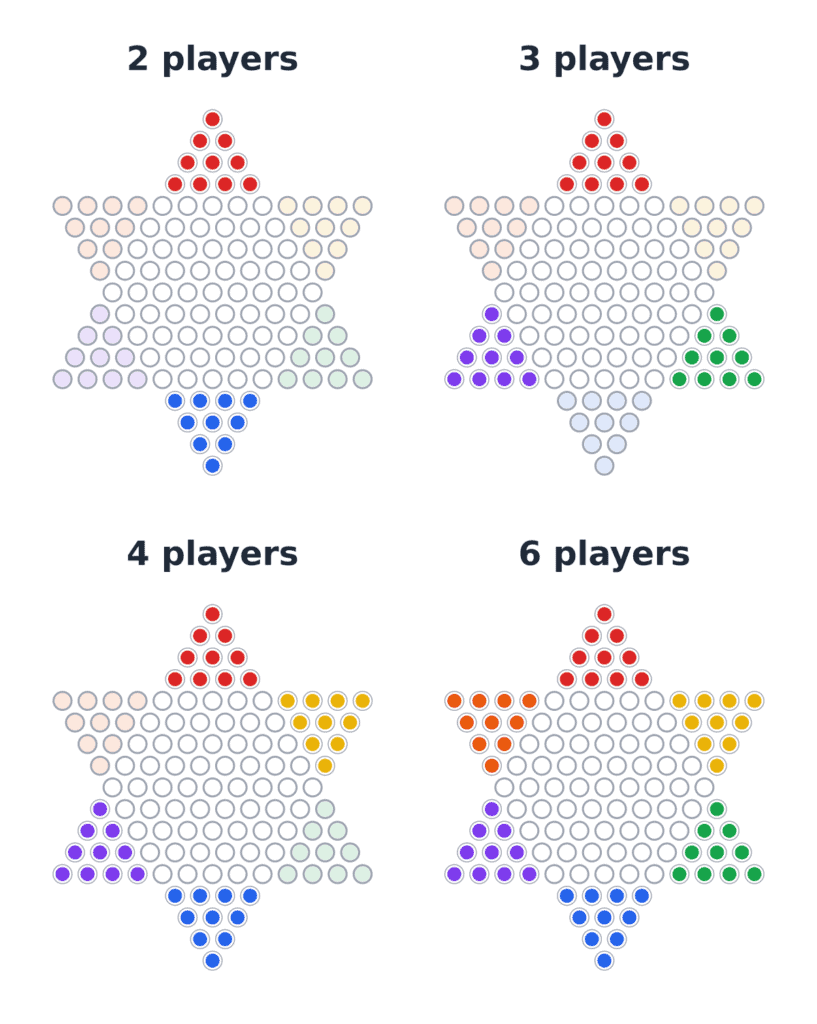
Each player starts in one triangle, and the number of players decides which triangles are used.
- 2 players: opposite triangles.
- 3 players: every other triangle, so the three camps are evenly spaced.
- 4 players: two pairs of opposite triangles. Every player has an opponent across the board, and two opposite triangles stay empty.
- 6 players: all six triangles. You can also play in three teams of two, with teammates sitting opposite each other.
Five players do not work, because one player would have no triangle across the board to aim for. Pick the first player any way you like, then take turns clockwise.
How pieces move
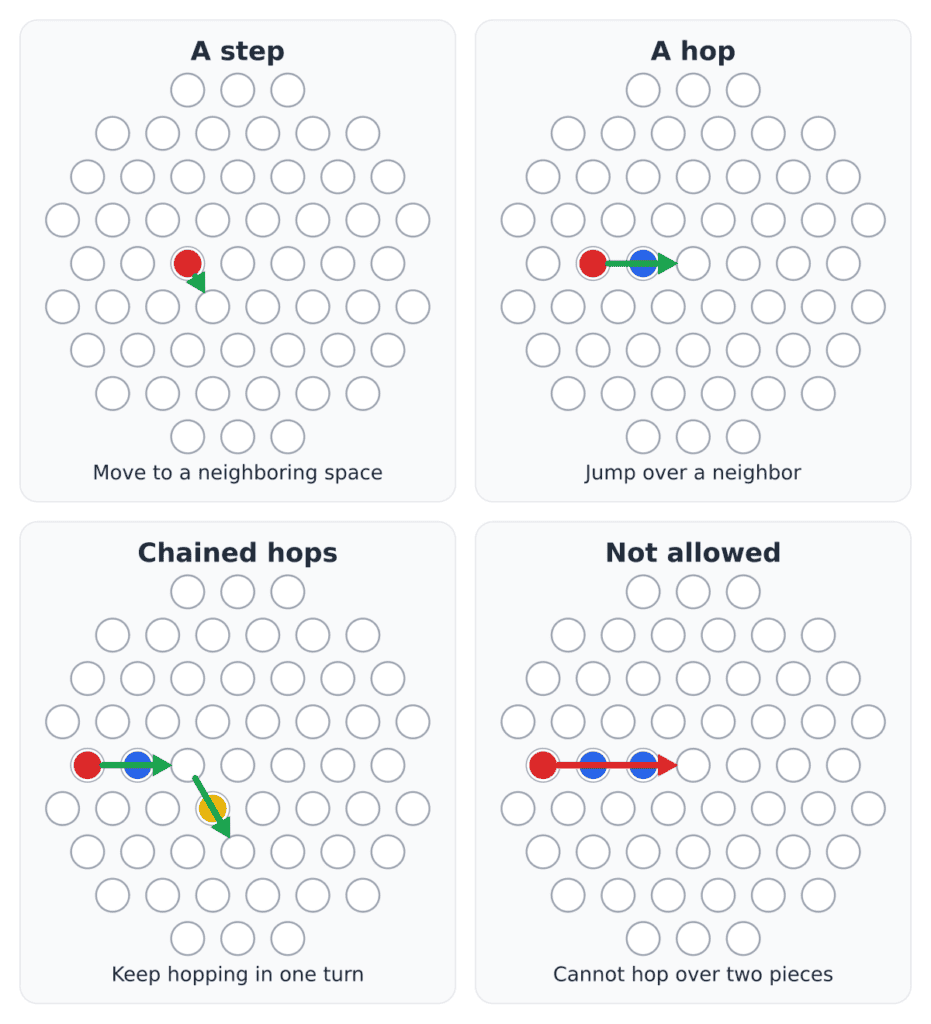
On your turn you move one piece, either with a step or with one or more hops. You cannot do both in the same turn.
The step
Move a piece to an empty hole right next to it. A hole has six neighbors, so you can step forward, sideways or backward.
The hop
Jump over a neighboring piece, yours or an opponent’s, and land in the empty hole directly behind it, in a straight line. The piece you jump over stays where it is.
Chained hops
After a hop, the same piece can hop again if there is another piece next to it and an empty hole behind that piece. You can chain as many hops as you like in one turn, and you can change direction between hops. You can stop at any time. Chained hops are how pieces cross the board quickly.
What is not allowed
You cannot hop over an empty hole, over two pieces in a row, or onto a hole that is already taken. Pieces are never captured or removed.
How to win
The first player to move all 10 pieces into the opposite triangle wins. Because pieces are never captured, a player could leave one piece in their own triangle to stop an opponent from filling it. To prevent that, the usual fix is to treat a triangle as full when every hole is occupied and at least one of the occupying pieces belongs to the player who is trying to finish. Our online game uses this rule. In games with more than two players, you can keep playing after the first winner to decide second and third place.
Tips for playing better
- Move your pieces forward together. A group is more flexible than one piece running ahead.
- Build ladders. A line of pieces spaced one hole apart lets a piece hop a long way in one turn.
- Use the center. It gives you the most paths across the board.
- Do not leave stragglers. One piece stuck in your starting triangle can cost you the game.
- Watch your opponent’s ladders. You can use them too, because you can hop over any piece.
Variations and house rules
- Teams: with six players, play in three teams of two. A team wins when both partners are home.
- Fewer pieces for young children: play with six or seven pieces each to make the game shorter and easier.
- Long hops: some versions let a piece hop over a distant piece and land the same distance beyond it. Agree on this before you start.
- Blocking: decide before the game whether leaving a piece in your own triangle to block an opponent is allowed.
Chinese checkers and checkers
Despite the name, Chinese checkers does not come from China and it is not played like checkers. The game was invented in Germany in the 1890s, as a simplified version of an older game called Halma, and “Chinese checkers” is a name that was added later in the United States. There is no capturing, and every player races instead of attacking.
Frequently asked questions
How many players can play Chinese checkers?
Two, three, four or six. Five players do not fit the board, because one player would have no triangle across from them.
How many pieces does each player have?
Ten, placed in one triangle of the star.
Can pieces be captured?
No. Pieces you hop over stay on the board.
Can I jump over my own pieces?
Yes. You can hop over any piece, yours or an opponent’s.
Can I move backward?
Yes. Steps and hops can go in any direction, although the goal is to move across the board.
Can I play Chinese checkers online?
Yes. You can play Chinese checkers online for free, against the computer or with a friend on the same screen.
Keep exploring
Play Chinese checkers online, try Connect 4 or browse all online games.